

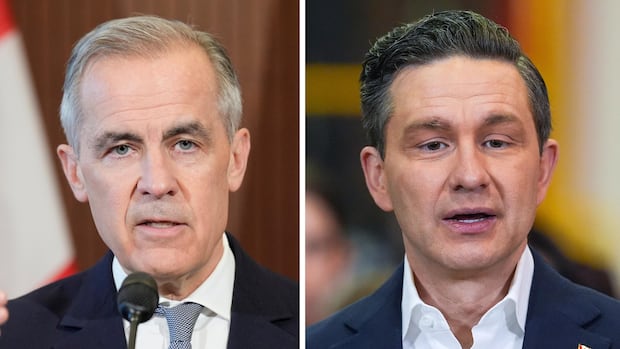



In his first year as prime minister, Mark Carney was restless.
Two days after being sworn in at Rideau Hall, he made official visits to France and the United Kingdom. Shortly thereafter he went into a five-week election campaign, and a week after last spring's vote he travelled to Washington.
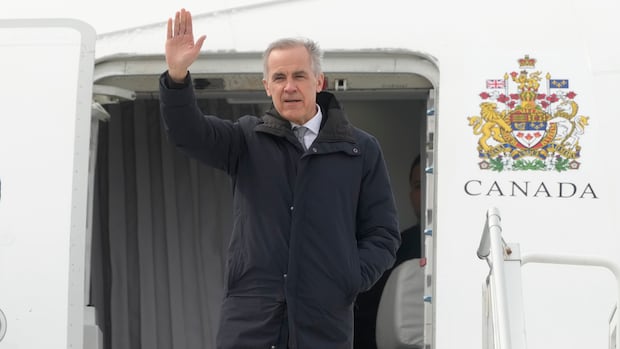
In the months since, Carney has been to Belgium, the Netherlands, Ukraine, Poland, Germany (twice), Latvia, Mexico, Egypt, Malaysia, Singapore, South Korea, the United Arab Emirates, South Africa, China, Qatar, Switzerland, India, Australia, Japan and Norway. He's made a second trip to France and been to the U.K. a total of three times. He's been to the United States four times.
By recent standards, that is a frenetic pace.
 Carney's trips to the United States have included two visits to the Oval Office. (Adrian Wyld/The Canadian Press)
In total, Carney spent 84 days either travelling or visiting other countries in his first year as prime minister. According to records provided by Global Affairs Canada, Justin Trudeau's first year included 63 days of travel. For Stephen Harper, the total was 34 days.
So much travel might simply reflect the moment Canada finds itself in or how Carney, a prime minister who came to the job with unique international experience, is choosing to respond to the moment. But perhaps it also marks a change in the job of prime minister — that from now on, that job is going to have to be more international in nature.
Is travelling good politics?In an appearance on the Herle Burly podcast in early January, Ian Brodie, Harper's first chief of staff, said he had come to the belief that international travel was a net negative politically for a prime minister.
"The problem is that when you travel you're giving up the domestic agenda," Brodie said. "We did some research on this when I was chief of staff. And when Mr. Harper was abroad … regardless of what he was doing and regardless of how well we planned the trip, he was losing ground in public opinion. He was losing media space and he was losing political support every day that he was abroad."
That conclusion, Brodie noted, ran counter to the conventional wisdom that being on the world stage allowed a prime minister to rise above domestic political conflict and appear statesmanlike. Brodie is of the view that Carney is spending too much time outside of the country for his own good.
Part of the counterargument to that might be that the world Harper faced is different from the world Carney faces now. The world of the early 2000s was by no means simple — Harper's first international trip was to visit Canadian troops in Afghanistan — but Canada's place in the world was not nearly as uncertain as it is now.
Dan Arnold, who oversaw polling for the Trudeau government until 2021, says he might have initially doubted the domestic political value of international travel, but eventually came to view things differently. In Trudeau's case, Arnold says, Canadians seemed to notice when Trudeau went abroad on official business (Trudeau was, for at least the first few years, something of an international celebrity). And that attention could be used to underline a domestic message — supporting the middle class, for instance — that the government was elected to pursue.
But in Carney's case, the travel itself is central to the idea he ran on.
"People are worried about Trump and they want Canada to engage with other allies. And in effect, him just even meeting world leaders and talking to them, I think reinforces the perception that he can handle the stage and that he is looking for new allies for Canada," says Arnold, who is now chief strategy officer at Pollara.
"That is core to his brand. It's core to what's on the mind of Canadians right now."
WATCH | What was the significance of Carney's Davos speech?CBC News chief political correspondent Rosemary Barton asked The National’s At Issue panel to break down the significance of Mark Carney’s Davos speech.The Conservative response to Carney's travels has been to argue that all the meetings taken and agreements signed have not produced tangible gains for Canada or Canadians. That's an argument the Carney government will have to contend with.
But the political high point of Carney's first year was arguably his speech at the World Economic Forum in Davos. When Pollara surveyed Canadians in February, 79 per cent said they had heard about Carney's speech and 59 per cent said it left them with a more favourable view of the prime minister.
There has also been a noticeable uptick in Liberal support in opinion polls conducted since that speech.
In a follow-up email this week, Brodie said he did think Carney's trip to India was a success on multiple fronts, including political relations, strategic positioning, national security and trade.
Does Canada need to rediscover the world?But beyond the short-term politics, it's also possible that the nature of the job of prime minister has changed — that going forward it will be harder for Canada or Canadians to treat international affairs as a secondary or separate concern.
The obvious reason for that would be U.S. President Donald Trump and everything his presidency represents. But some reinvestment in foreign affairs may have been called for regardless of who became president last January.
"I think it was probably necessary with or without Trump that Canada, from the leader level on down, get more engaged internationally," says Kerry Buck, a former Canadian diplomat who was ambassador to NATO from 2015 to 2018.
In Buck's view, relations with the United States have been treated as "necessary and existential" but everything else became "kind of optional" in recent decades. In an essay published last year , she wrote that with global threats increasing and with "Fortress North America" no longer providing the security it once did, "Canada needs to start seeing international engagement not as optional but rather in Canada's existential interest."
Canada, she says, had been getting "more and more parochial over the years" and we need to view foreign policy as an "integral part of our governance."
"It's not optional, fun and pretty, shiny jewels in the window," she says. "It's everyday, bread-and-butter of our existence as a trading nation and a nation that, although we're more secure than others because of our geography, it is definitely not a given."
 Carney stands with his German and Norwegian counterparts as they observe a military exercise earlier this month. (Adrian Wyld/The Canadian Press)
The value of international travel might often be measured by the agreements that are signed or the images that get beamed back to Canadian voters. But Buck says face-to-face meetings are also important for building relationships between leaders — creating the sort of trust and understanding that can be called on later.
But if finding new trading partners and building new alliances is central to Carney's agenda — if such things are indeed necessary for Canada going forward — then it's also fair to ask whether the Carney government is going to end up undercutting itself by reducing foreign aid and making cuts at Global Affairs Canada. On trade, for instance, Buck argues that GAC officials can be integral to connecting Canadian businesses with new partners.
It must be said that however much Carney wants or needs to turn his attention to the world beyond North America — and however much Canadians are happy to see him doing so — there are still obvious domestic concerns that can't be ignored. Brodie's concern was that the Carney government wasn't paying enough attention to national unity concerns in Alberta and Quebec. And the affordability of housing might still lurk as the Carney government's biggest vulnerability.
But Canadians and their prime ministers might no longer live in a world in which Canadian foreign policy can be treated as a purely secondary or academic concern.