



A very quiet queue has formed in Europe where some of Canada's long-standing, closest allies are seeking shelter under France's small but robust nuclear umbrella.
The initiative of French President Emmanuel Macron, who declared the next 50 years to be the "era of nuclear weapons," is — on paper — intended to add another layer of deterrence to NATO's American-backed security guarantees.
Once again — on paper — Russia is the adversary that needs deterring.
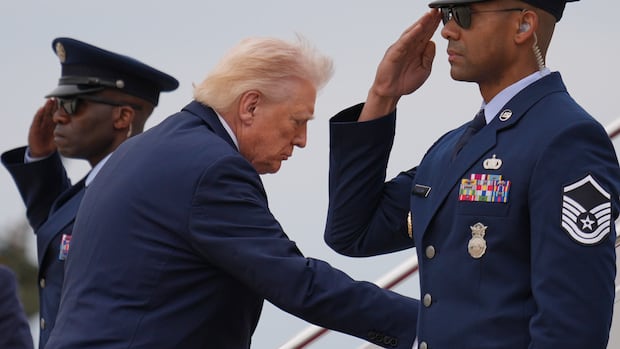
But with U.S. President Donald Trump once again trash-talking NATO allies over their reluctance to join his war in the Middle East and the sensational — but hardly surprising — Financial Times report that Denmark was preparing to put up a fight to defend Greenland against American annexation, a whole new dimension emerges to the French advanced nuclear deterrence strategy.
Should Canada join that queue?
WATCH | Trump says NATO is making a 'very foolish mistake':U.S. President Donald Trump on Tuesday said NATO countries were supportive of the joint U.S.-Israeli military operation against Iran, even as they decline to get involved. 'All of the NATO allies agreed with us ... and they don't want to help us, which is amazing,' he said during an unrelated Oval Office event with Irish PM Micheál Martin.Consider for a moment that Denmark is one of the eight nations in the negotiating line and presumably wherever deterrence assurances are given (France has already ruled out explicit guarantees) would extend to Greenland.
Had the arrangement already been in place in January, how would that have changed the annexation equation?
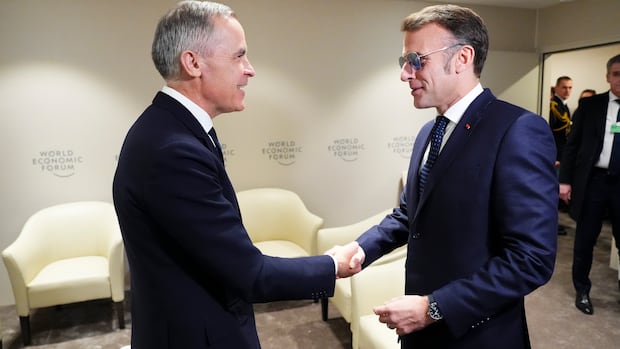
When Prime Minister Mark Carney and five Nordic leaders met the media last Sunday in Oslo, the most uncomfortable moment came when the question of the French nuclear deterrent was raised.
Judging by the sheepish expressions on some of the leader's faces, nobody wanted to speak the quiet part out loud.
Canada had no intention of going nuclear and acquiring its own deterrent, Carney said.
And although there is a difference between acquiring your own nuclear weapons and sheltering under someone's deterrent, Carney delivered cautious praise for Macron's initiative to extend the reach of France's arsenal.
"We commend that initiative from a NATO perspective, from a European security perspective. It's not directly affecting Canada," Carney said, while noting the details of the French plan are still subject to negotiation.
There are eight countries in the queue: the U.K., Germany, Poland, the Netherlands, Belgium, Greece, Sweden and Denmark. Britain has its own, smaller nuclear force which is closely integrated with the United States in terms of technology.
France's arsenal is fully independent and has made the issue of command and control — the so-called one-man, one-button notion — a non-starter in negotiations with other nations.
The partner nations would, Macron has said, participate in the development of auxiliary systems under a new French nuclear doctrine, including space-based alarms, air defence systems and long-range missiles.
WATCH | Carney asked about defence of Greenland:Prime Minister Mark Carney, in Oslo for a mini-summit with the leaders of five Nordic countries, was asked by a Danish reporter whether Canada would commit troops to defend Greenland if another NATO ally tried to seize the territory — a reference to U.S. threats to take over the island. Carney said territorial sovereignty must be upheld and the future of Greenland and Denmark is up to their people. 'We will back that with measures as necessary, as a partner,' he said.It leaves open the question of whether Canada — with its now freer access to the European defence market — would stand to benefit in some way.
The number of French warheads will increase from around 300, but Macron wouldn't specify by how much. The country is also renewing its nuclear submarine fleet.
From a NATO perspective, the combined French and U.K. nuclear deterrent can't replace the U.S. nuclear umbrella, the U.K.-based Royal United Services Institute argues in a recent paper.
"It will never resemble the U.S. or Russia — in numbers or posture," the paper said.
Russia fields around 1,500 strategic warheads while the United States reportedly possesses 5,177 — 3,700 active stockpiled warheads and 1,477 retired warheads awaiting dismantling. That's according to data from the Russian Foreign Ministry and the Bulletin of the Atomic Scientists.
Having a nuclear weapon doesn't necessarily mean it would be used. The threat is often used to greater, less devastating effect.
Russia has turned nuclear threats toward NATO nations supporting Ukraine into a veritable cottage industry.
In the category of two can play that game, some experts suggest the French nuclear deterrent could be useful in the event the United States further retreats from Europe.
"The deployment of French nuclear-armed jets to countries such as Germany and Poland would send a message to the Kremlin that Paris may be ready to conduct nuclear deterrence operations alongside its allies and act on their behalf," Juraj Majcin of the European Centre for Policy Analysis wrote last week.
Both Norway and Finland made clear during the media availability they were not willing to host forward-deployed nuclear weapons — be them French or American. However, Helsinki is in the process of amending its legislation to remove legal barriers to such an action if it ever becomes necessary.
The French military also last week sent a non-nuclear message advertising how its heavy A400M Atlas transport conducted a risky landing on a floating chunk of ice in Greenland along with troops of the 27th Mountain Infantry Brigade.
It was a gentle reminder that they stand alongside the Danes.
Sending nuclear-tipped jets to Greenland in a renewed crisis would be a whole other matter.
And while Trump has backed off of his Greenland threats for now, it was clear Nordic leaders were hoping for the best by planning for the worst judging by their responses last week.
This is where Carney's mushy answer becomes significant.
Extending the potential line of French nuclear deterrence from Greenland into Canada would be risky, perhaps even calamitous.
Trump's 51st state musings and repeated Canada bashing have rattled the country to an extent almost unthinkable a few years ago — a public debate about whether a nuclear deterrent was necessary.
WATCH | Trump orders new nuclear tests:Trump ordered the resumption of nuclear weapons tests for the first time since 1992. A day earlier, Putin said Russia had successfully tested a nuclear-powered super torpedo.Writing last year in Policy Options magazine, political science professor Julian Spencer-Churchill said that a full-blown attempt by Canada to acquire nuclear weapons technology would likely provoke the Trump administration — up to the point of possibly taking pre-emptive action.
"A formal Canadian nuclear program, designed to assure its citizens, would instead excite anti-Americanism to new heights and would likely provoke a physical and irreversible U.S. intervention," Spencer-Churchill wrote.
He went on to argue that there's no political will in this country for a homegrown nuclear weapons program and such a scheme would require a dramatically heightened security regime to guard against theft.
It may well be his arguments against Canada acquiring the bomb could also be transferred to the notion of openly joining France's extended deterrence.
During that same media availability last week, Carney was asked point-blank by a Danish reporter whether Canada would send troops to defend Greenland in the event of a U.S. annexation attempt.
"We stand four squares behind the principles of sovereignty, territorial integrity. It is for the people of Greenland and Denmark to decide their futures," Carney responded.
"We will back that with measures as necessary."
Because of the six-nation format of the news conference, the question that wasn't asked of the Nordic leaders — but should have been — was: How far would Europe be prepared to go to defend Canada?