




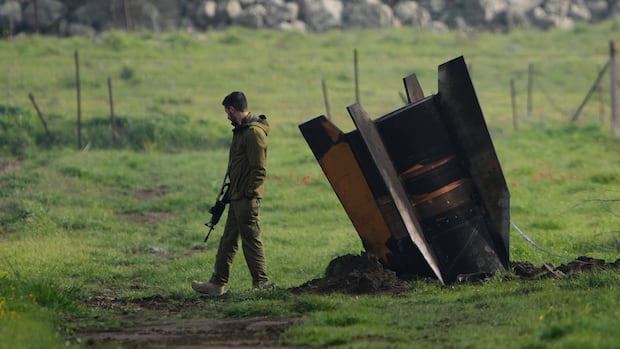





Despite continued heavy pounding from U.S. and Israeli military forces, Iran has remained defiant, insisting that its missile production remains on track.
On Friday, Gen. Ali Mohammad Naeini, spokesperson for Iran's Islamic Revolutionary Guard Corps, told the state-run IRNA news agency that the country is producing missiles "even during war conditions, which is amazing, and there is no particular problem in stockpiling."
(Naeini was later reported to be killed in an airstrike shortly after the statement was released.)
His comments also came as Iran's top military spokesperson, Gen. Abolfazl Shekarchi, warned on Friday that "parks, recreational areas and tourist destinations" worldwide won't be safe for Tehran's enemies.
But are these comments just "showmanship and exaggeration," as one observer described them, or does Iran still have the capacity to build more missiles and pose a significant threat to tourist targets within the region and abroad?
How many missiles did Iran have when war began?Since the U.S.-Israeli war against Iran began on Feb. 28, Tehran has struck back by launching missiles both at Israel and at its neighbouring states.
Those include Qatar and the United Arab Emirates, whose U.S. military bases, civilian sites and energy operations have all come under attack.
Iran has also attacked Saudi Arabia’s vast Eastern Province, home to many of its oilfields, as well as Kuwait and Bahrain.
Before the war, Iran was considered to have the largest and most diverse missile arsenal in the Middle East that included thousands of ballistic and cruise missiles, with ranges of up to 2,000 kilometres.
The exact size of its missile stockpile before the war was unknown, as many were either used or destroyed last June during Iran's war with Israel. However, estimates ranged from 2,500 by Israel's military to about 6,000, according to other analysts.
For example, Alex Plitsas, a former Pentagon official and currently a senior fellow with the Atlantic Council, an international affairs think-tank in Washington, D.C., said that before the war, Iran was estimated to have somewhere between 2,000 and 3,000 medium-range ballistic missiles and between 6,000 and 8,000 short-range ballistic missiles.
What has been destroyed?U.S. President Donald Trump said last week that Iran's ballistic missile capacity was functionally destroyed. But U.S. Gen. Dan Caine, chairman of the Joint Chiefs of Staff, said on Thursday that Iran still retained some missile capabilities.
Meanwhile, Israeli Prime Minister Benjamin Netanyahu said on Thursday that Iran's missile and drone capability was "massively degraded" with hundreds of launchers destroyed. Israel was also hitting missile and drone factories.
WATCH | Iran launches missiles at Israel:Iran launched several missile attacks toward Israel on Friday, sending residents into shelters as fighting between U.S.-Israeli forces and Iran showed no sign of ending.The United States and Israel have not been clear about how many of these facilities there are, how many they've attacked and their battle damage assessments, said William Alberque, former director of NATO's Arms Control, Disarmament and WMD Non-Proliferation Centre and a senior adjunct fellow with the Pacific Forum, which is based in Honolulu.
While Iran's above-ground missile production has been damaged or destroyed, he said, "we don't know what we don't know."
Alberque said a big question that remains is how much capacity Iran has underground, noting it's likely relatively limited for big missiles but that there's enough capacity for lots and lots of drones or smaller cheaper missiles.
"Of course, it's in Iran's interest to seem as strong as possible. And so there's a degree of showmanship and exaggeration here as well," he said.
Iran is "miles below their pre-conflict capabilities" both from the current war and from the June strikes last year, Alberque said.
"But it is a non-zero capacity, and we simply can't know — and Iran does not want us to know," he said.
Can Iran still produce more missiles?Gary Samore, director of the Crown Center for Middle East Studies at Brandeis University in Massachusetts, said he believes it’s very plausible that Iran is continuing to produce drones during the war because they can be manufactured from simple components in anyone’s basement or garage.
But he doubts that Iran is still able to produce bigger, longer-range ballistic missiles because the U.S. and Israel have destroyed or disabled known production facilities.
The Atlantic Council's Plitsas said with the U.S. indicating there are several weeks of operations left, additional targets could include potential missile production. However, he said he would "find it hard to believe at this point that there is major missile manufacturing capacity left."
Plitsas estimated that Iran's capacity to build missiles was about 300 a month at the start of the war, and that may have been whittled down to a current level of about 40 a month. "That's a single day's volley, so even if they're producing somewhere around there, it's still negligible," he said.
 Firefighters try to extinguish flames at the site of a direct hit by an Iranian missile strike in Holon, central Israel, on March 13. (Ohad Zwigenberg/The Associated Press)
Alberque agreed, saying just by looking at the numbers that have been estimated of daily drone and missile launches, it's clear that Iran's missile capacity is relatively low.
"So now they're trying to ration strikes. But this is clearly not a country that has hundreds and hundreds of missiles ready to go," he said.
"I would say their threat within the region is still significant but dropping — certainly far below where it was," Alberque said.
Still, Plitsas pointed out, "they only need to get a single missile or a few drones to destroy oil and gas and wreak havoc."
Could Iran strike tourist sites worldwide?When Gen. Shekarchi said worldwide parks, recreational areas and tourist destinations could become targets, it wasn't clear if he was referring to missile strikes.
"I think that kind of talk is really sort of baffling, pointless bravado from the Iranians that they can strike anything outside the region," Alberque said. "I would say their threat outside the region is very, very low."
WATCH | Gas site in Qatar could take years to repair::Qatar says an Iranian strike on Ras Laffan, the world's largest liquified natural gas plant, has taken out 17 per cent of its export capacity. Persian Gulf states are also major producers of fertilizer, and concerns are mounting over what may happen to global food prices should that supply chain be disrupted.Iran doesn't have intercontinental ballistic missiles, meaning they couldn't strike targets in the U.S.
And anything Iran launched toward members of the North Atlantic Treaty Organization, largely in western Europe, is going to be intercepted by NATO's missile defence, along with U.S., British and French assets, Alberque said.
Plitsas said he also doesn't believe Iran would specifically target the tourist destinations of its Gulf neighbours "because nobody's really vacationing in the Middle East at this point."
When the Iranian general said "worldwide," he was likely referring to international sleeper cells that could launch a terrorist attack, Plitsas said.
"This could also be propaganda designed to instil fear, but it's also entirely possible that they're capable of carrying something like that out," he said.
"So out of the comments that have been made, that's the more serious one that I would be very, very concerned about."